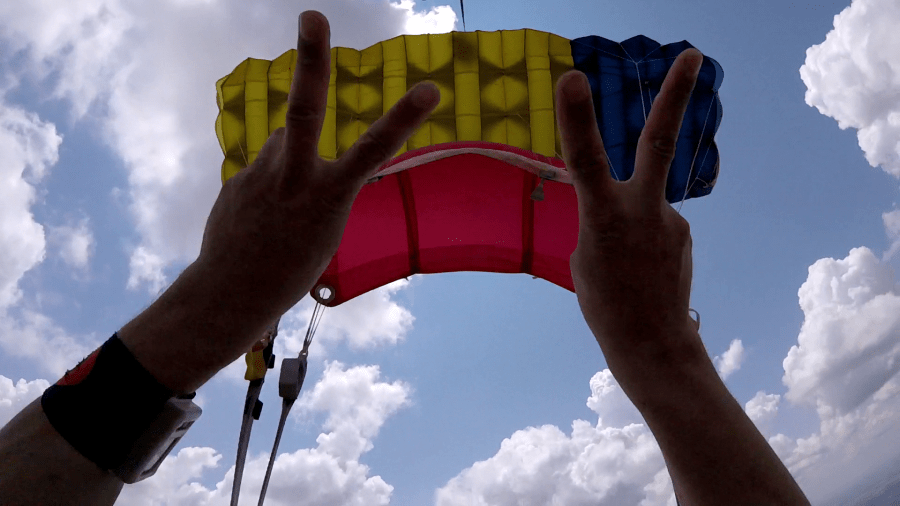
I decided to go skydiving the day after the 4th of July holiday. I thought it might be a good day to go (weekdays are less crowded), but it seemed plenty of other people were also thinking the same thing. I got in about 8:15, and as a result I missed my first chance at running through Emergency Procedures (EPs). It is just tough getting up early enough to make the 1:45 or better drive and be there by opening time.
I got to run through my EPs a little later with 2 other students, then get in line for my turn to do my Level 2 (of 18) jump. Bill (the same instructor from my previous jump) was my instructor for the next one. I’m not adamant about using the same instructor; I figure that working with several gives me a chance to see different variations of techniques and find out what works best for me. Bill is a great instructor, so I was happy to pair up with him again. We ran through the check on my pack to make sure everything was good (of course it was). I got geared up and waited my turn to get on the plane. All of my jumps have been out of the single engine Cessna Supervan they have, I do wonder what it will be like solo jumping out of the twin engine Super Otter (will the prop wash be noticeable at speed).
Bill did his normal routine of quizzing me about procedures and altitudes on the way up. We got to jump altitude and waited our turn. Before I knew it, it was my turn to swing to the outside of the door, get my “go shake” (Bill shakes me to let me know he’s ready so I don’t have to turn my head to look at him in the door), and step out. This jump seemed different; I was having more trouble with keeping my body stable than my first non-tandem jump. I needed to get stable so I could do my tasks for this jump, which were to use my arms to turn 180 degrees right and then back 180 degrees left during free fall. While still trying to get good and stable, my altimeter came off a the wrist; the only thing holding on was the loop that goes around my finger. I reached over with my right hand, grabbed the altimeter, and placed it into my left hand so I could hold it and actually read the numbers. The rule is that if you don’t know what altitude you are at, you are to pop your chute immediately, so getting the altimeter back into a state where I could read it was top priority. After that I never did get stable enough to do my turns. As I had started my wave to signal I was deploying my parachute, bill signaled to “pull”, so it was good timing.
While the free fall was essentially a failure (I didn’t get my turns done), my flight under canopy went well. I did my brake turn practice as required for this dive flow, and lined up for a decent pattern. I tried to land standing up, but didn’t quite time it right, so I ended up doing my standard parachute landing fall (PLF) to spread the impact out. Back in the hangar, Bill went over my video and told me the biggest issue was me not arching enough.
Things picked up at the drop zone (more students showed up), so Bill ended up handing me off to Cody. Cody is actually an employee of Skydive Spaceland Houston, but he was in town after the holiday and decided to show up and see if he help out. I’m glad he did – he spread the load out and let more students get handled in a more timely manner. Cody with through the pack checkout with me again, and we got ready to jump. Bill was on the same plane with a jumper that needed to re-certify (If you go too long between jumps, you have to re-certify with a licensed instructor). This time I made darn sure that the altimeter was well fastened, using a rubber band to further secure the velcro closure. It came time, and off we went.
Things never were quite right when we jumped, I was even more unstable than before. I kept trying to adjust my body position, and it just kept getting worse. It was not long until Cody and I were spinning upside down. If you think about the shape we formed with Cody hanging off the side of me, we made a “T”, and the spin was basically like someone had thrown a hammer. Ultimately, the spin got so strong that Cody had to let me go. At that point, my mind was going through what I needed to do (at least I wasn’t freaking out!). A big rule is that if you lose your instructor, you pull your chute. However, you need to be stable to get a good parachute deployment. If I pulled while spinning upside down, I was pretty much guaranteed I’d have a “big ball of crap” over my head, and would be likely to have to cut my main chute away and go to reserve. So I decided to give myself a few seconds to try and get things worked out. One thing in training they tell you is that if you arch, things will self correct. That’s exactly what I did, and within the matter of a few seconds I was face to earth and stable and I deployed my main chute immediately. I never was really what you would call scared. Was I aware of the situation, and concerned with finding a resolution? Dang right I was. Fear is there to help keep you from getting in a situation, but once you are in it, fear doesn’t provide any benefit other than to distract you.
After I saw I had a good canopy overhead, I went to my tasks of making sure I had a good steerable canopy. This is something you do every time after you open your chute. You flare, steer right, steer left, and flare (brake) again. After that, you know if you have a controllable canopy. Since I had pulled early (sooner than the normal 60 seconds of free fall), I had a longer float time down to the ground. I won’t deny I enjoyed the extra time. Honestly, flying under the canopy might just be better than the free fall as you have a little more time to enjoy the view. My landing was better than the last, it was actually very close to the target. I did end up doing a fall again (PLF) instead of standing the landing. Cody didn’t beat me up about what happened. We talked about how it could be avoided, but while not happy about the failed free fall (I clearly didn’t get my tasks done). However, he seemed happy that I was able to correct the spin and deploy. I later heard him telling other instructors outside (he didn’t see me) that he had to let go of a student for the first time ever today, but the student knew what to do and did it.
The major factor that caused the spin was my not exiting the aircraft properly. I was not arched enough, and did not exit facing squarely forward. As a result, it started us into the spin that soon became unrecoverable when coupled with my poor arch.
There was quite a delay for my next jump. I know you might be thinking: “Dude, you just had a bad jump, and you are going back for more?”. Here’s the thing: I didn’t want to leave for the day having been beaten. Was I a little concerned? Sure, a little. But I had just proven to myself that I could handle it when things go wrong. Don’t get me wrong; It would have been better to not get in that situation, and I certainly don’t need to get over confident or complacent. But it is also a confidence builder to know you handled it.
After winds calmed down and I got on another jump load, we were good to go. Load time came, and Cody and I were back on the plane. I was thinking through what I needed to do. I knew I needed to present better holding on to the plane while hanging outside getting ready to jump. I also knew I needed to arch. We exited the plane and I immediately knew things were better. I felt a slight twist coming off the plane, but it corrected almost immediately and we were in stable free fall. Now the real work began. It took a bit to get my posture right; Cody kept telling me to correct my leg positioning. Basically, they should be at about a 45 degree angle at the knees. Falling through the air, it’s tough for me to gauge the right position and KEEP them there. I got close enough and I got the thumbs up from Cody. My first job was to do 2 practice touches to prove that I knew where the handle was for the pilot chute. Another leg position correction, and then I was doing my free fall turns. When done, I was past my altitude to end turns by 400 feet (I was supposed to stop at 7000). When you are falling 1000 feet every 5.5 seconds, it doesn’t take long to cover that extra 400 I had. I shook my head to indicate I was done turning, locked on to my altimeter, and pulled at 5500 feet as planned.
After I knew I was under a good canopy, I did a little shout; I finally got this right and I knew I would pass my Level 2 jump as long as I didn’t botch the landing. Flight down went good. I was running a little short on distance, so I didn’t get into my holding pattern and do an “L” approach. I basically went straight into my final approach. I came up a little short of the target, but I was well within the bounds of the landing area. Most importantly, I pulled off a standing landing this time. Cody was cheering over the radio. While I had not mentioned it prior, we have a radio on us that lets the instructor guide us in for the approach and help us time our flare. The flare is when we trade forward motion to reduce our drop speed.
I got my chute bundled up, and walked back to the hangar a happy camper. I hung out several hours after that hoping to get my Level 3 jump in, but it never happened. Our wind speed limit as students is 16 MPH. If the wind spikes over that, even once, we have to wait 20 minutes with no more spikes over 16 MPH. After about 2 hours, I called it and went home. But not before saying goodbye to Cody. He was an awesome instructor. Instead of letting me get down about my issues with the jumps, he was upbeat and kept motivating me to improve and get the next jump in. I’d definitely jump with him again. I also thanked Jenna, the chute packer that had repacked my parachute after my jumps. You have to be thankful for the person taking their time to pack that parachute right. Every opening I had was a clean one.
On the ride home, I spent some time thinking about the jumps. I think a lot of my problem is that I was so focused on correcting previous issues (arm position, etc) that I let it tense me up and cause problems else where. I’ll be practicing my arch at home and getting ready for when I do get that Level 3 jump in. I also walked away feeling as if my 2 fails at the Level 2 jump were not a complete loss. I learned some things as a result, not the least of which is that I feel I can trust myself to keep my wits and try to work through high pressure issues in the air. It also felt good to not have let those 2 bad jumps send me home packing. Getting on my steep pitched roof (I had to do that today to clear out my clothes dryer vent) makes me more nervous than jumping out of a perfectly good airplane. Don’t get me wrong – I don’t have it all figured out. Not even close. I have so much to learn it isn’t funny. But that is part of what makes this experience fun for me – there is so much new information from a domain I know nothing about. Refreshing!
I’ll have a post soon showing how I’m adapting some technology to help me with my learning. Basically taking devices meant for other sports and adapting them to get some useful data in the skydiving domain, without having to pay big money for specialized tech.
So here’s the videos. Don’t let the spinning video freak you out. It clearly all ended well.
Dive Flow 2 Failure #1, Unstable and had my altimeter come loose. Also notice my instructor had to deal with line twists on his deployment.
Dive Flow 2 Failure #2: THE BIG SPIN. You can quit watching after 50 seconds or so; I need to upload a trimmed down video.
Dive Flow 3 – FINALLY!


Omg. I was scared reading about your spin. And crazy me – I watched the video. Omg. And knowing what he said to other instructors??? Nooooo way. Stress me out. Way to get back on that horse though.
LikeLiked by 1 person