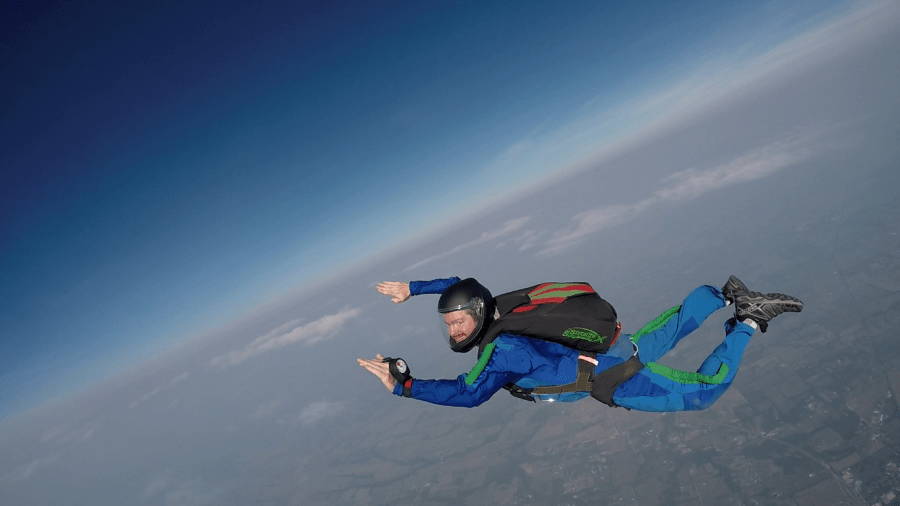
A Great Day Flying

I had planned to try and take the whole week off to take advantage of a possible down time opportunity. Of course, that never works out, but I did take Wednesday off and Thursday morning/early afternoon.

Wednesday turned out to be one of those perfect days. I walked out of our front door at 5AM, looked up, and there was my favorite constellation – Orion. Got to the drop zone early, sat on one of the benches outside and watched the sunrise. Shortly thereafter, I got a call from a friend I hadn’t heard from in a bit and was excited to hear from them. There was just no way it couldn’t be a good day. Oh yeah, I was excited to try out my new helmet. I finally invested in my own helmet after Daniel said I could get a “big boy” helmet 🙂 A $400 helmet for that $10 head of mine.

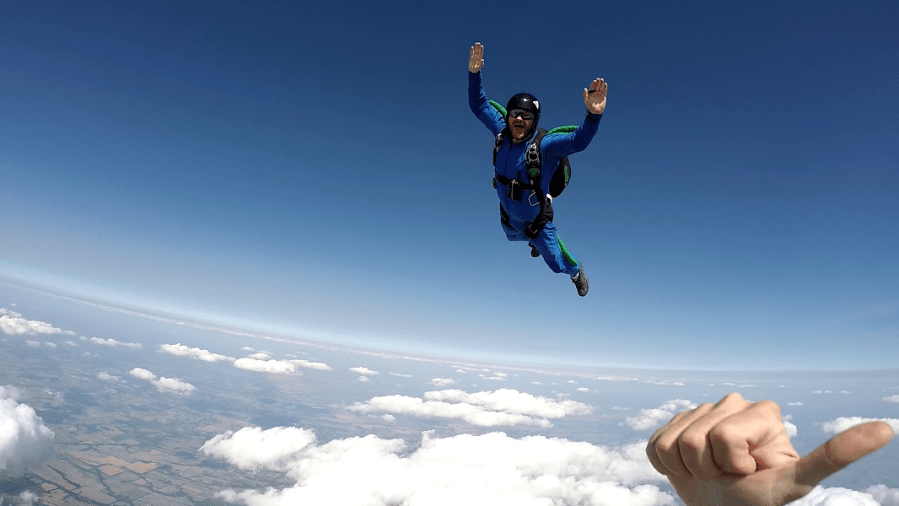
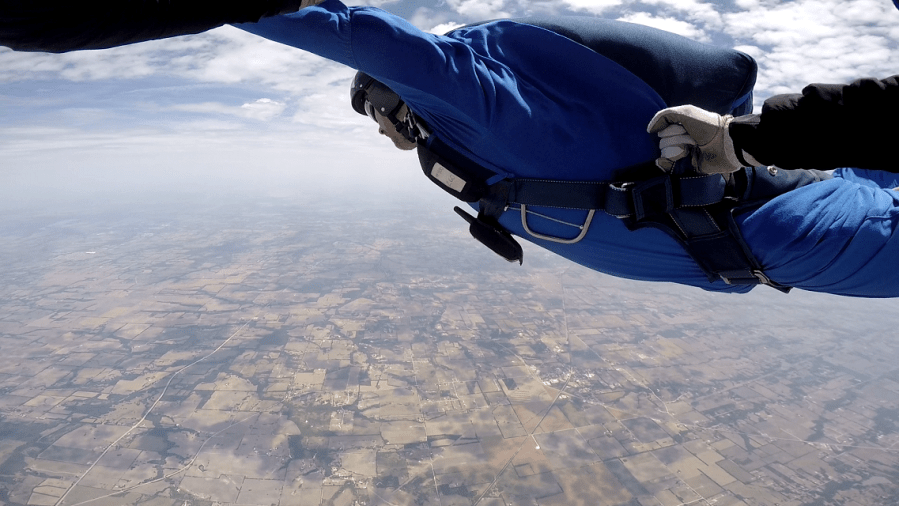
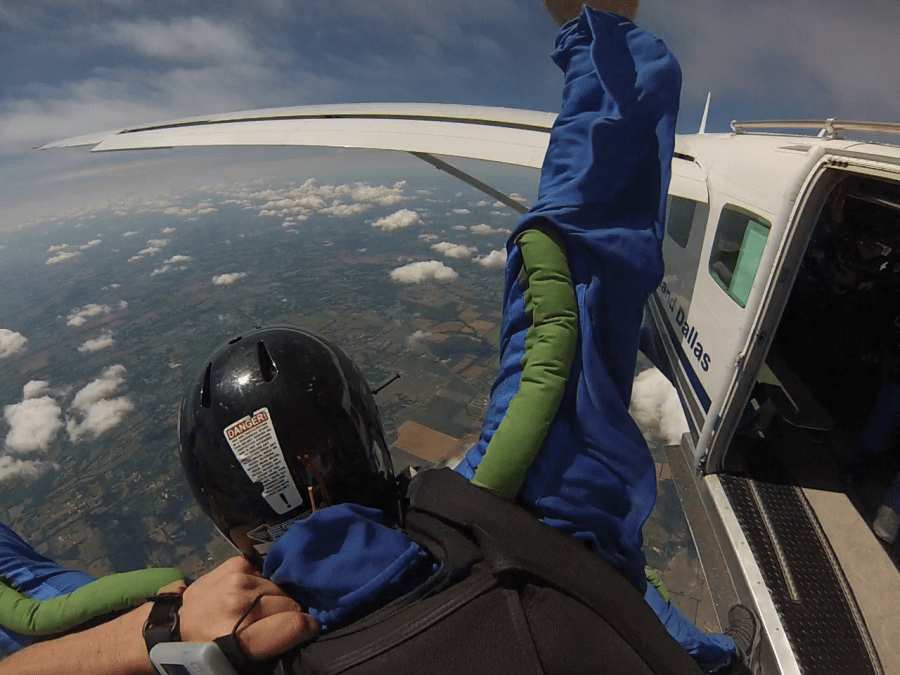
I got inside about 7:30, grabbed my favorite rig, and started my gear checks. A couple more students showed up, and we were then run through our emergency procedures. I talked to my instructor (Daniel) about the plan for the next jump. He talked me through barrel rolls and what I would need to do. Before long, the propeller was spinning, we were loading on the super caravan, off we went. I did a poised (standing exit) on the edge of the plane as I had before. I got another good exit, and that just set me up for success. My first barrel roll went well, the second one did not have enough momentum, so I stalled out mid turn and had to re-stabilize. I then flew up to, and docked with my instructor. After that it was time to lock on to the altimeter and get ready to pull. The canopy flight down was nice as always. I’m still working on landing right on the mark (I need 5 landings within 20 meters before I can get my license). Here’s the video for that jump.

We reviewed my video and filled out my logbook. Then it was time to wait for my rig to get re-packed and get ready to do flips on Dive Flow 8. I also learned I was going to be doing a diving exit out of the plane rather than the poised exit. I was a little nervous about it; doing something new in that environment always makes me a bit antsy, but not so bad I couldn’t function. I’ve learned relax, arch, and things right themselves; it still takes me a few seconds when I’m in the air sometimes to remember that and make it happen though. My exit wasn’t perfect (I flipped over and had a moment of instability after), but it worked out. Then on to flips. My first flip didn’t have enough momentum, much like my second barrel roll; stalled out and had to recover. My second front flip was much better, carried all the way through. My instructor was signalling to me, but I didn’t quite get what he wanted. He was trying to tell me I forgot to do a back flip. I did my lock on, pulled, and next thing I found myself with line twists.

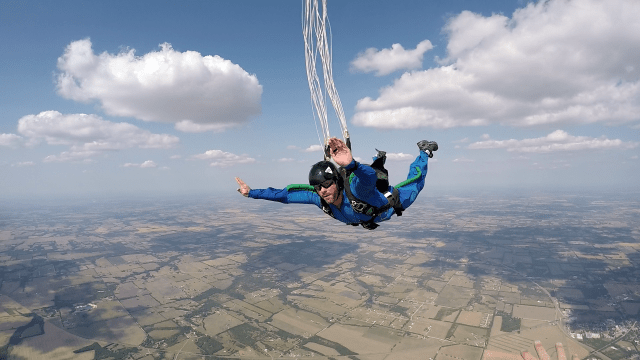
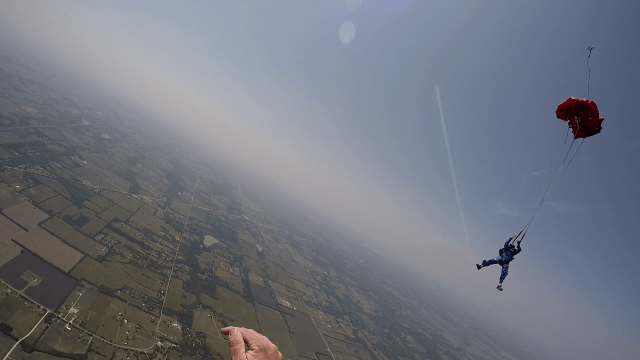
We had been told in ground school that we would see line twists sooner or later. That time had come for me on my 11th non-tandem jump. I did what I was trained to do; I grabbed my riser straps and pulled them apart while kicking and swinging my hips. Worked like a charm! Up until that point I had been afraid of twists because they were an unknown. Not any more!
vlcsnap-2018-08-23-22h25m40s348
This is what line twists look like. This is actually from 2 jumps later (foreshadowing)

OOPS! I didn’t realize what I had forgotten to do in free fall until I was safely under canopy (after getting rid of those line twists). Back in the hangar, Daniel asked me “What I thought about my back flip”, to which my response was “you mean the one I didn’t do?”, and we both laughed. I’m still learning to let things go and not beat myself up over everything. I had proven I could re-stabilize after being unstable, which was the main point of that dive flow.

We had a bit of a wait after that for my next jump. Other students had come in and they needed their turn. Also, there was a “mascot” jump. A local sports team had joined up with Spaceland to get some video of a tandem with the passenger wearing the mascot suit. Pretty interesting turn for the day.

mascot_jump
Having some fun….

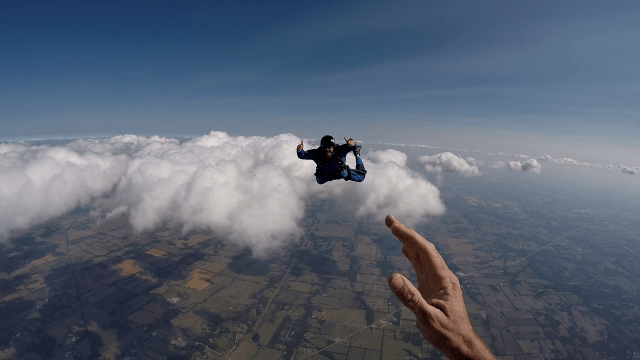
After waiting a couple of hours for my chance at jump 3 of the day. This was my second diving exit, and my first tracking jump. Tracking is where you bring your hands to your side and start moving forward, FAST. My 2nd diving exit was a lot better, I think I remembered to look at the wing tip as I exited. Then Daniel backed away from me, and I started tracking towards him. As I neared, he signaled to me to quit tracking. I had hoped to do that without prompting, but it is still a learning process. I then proceeded to dock with him. After that, I checked altitude, he pointed in the direction to track, and I tracked for about 4 seconds. I have to admit feeling the speed is good. But you can’t enjoy it too much (gotta remember surroundings). Got a good canopy, no line twists this time. Back down, and fill out the log book and talk the dive over with my instructor.

I had come into the day saying I wanted to get 4 jumps in. After the lull in the middle of the day, I was beginning to wonder if that was going to happen. It worked out. I got on the last load of the day for my 4th jump. My instructor added something new, a different exit type. We did what is called an “open accordion” exit. The instructor is outside the plane holding on to the rail facing in. I’m inside the plane kneeling like I’m getting ready for a diving exit. He grabs my rig, I grab his rig.  We do a count, and exit together. I was a bit nervous about it, as it was yet another new thing I had not done yet. But it went pretty well. We got an exit, after a few seconds, he released me, and we went into tracking exercises.  My first two tracks were pretty good. Then for my final track, Daniel had me spin 180 and go the other direction. It was more unstable, all due to the fact that I had done things too quickly, I spun around too fast, then tried to force the track even though I wan’t perfectly stable. I recovered, but it was clear what I had done. Daniel asked me what the problem was on the ground (he already knew the answer, but wanted to hear me say it), and I told him what I thought I did.

I finished up my log book, went over the jump with Daniel and called it a day. It had been a really great day. I can’t say “best day ever”, because all great days are different and not directly comparable (wedding, childbirth, other major milestones). But I hope to keep this day near and dear too. We had a lot of students in that day, we were sharing our dive videos and talking. Some of my favorite instructors were there, and Tyler (my excellent wind tunnel instructor was there too). There’s just something about being on that ride up with folks you know and like.

They say if you use the “first” in the drop zone, you owe beer. But I’m going to use that word here on my blog (sue me). Here are my firsts for the day:

  • Jump with a closed face helmet
  • Diving exit
  • Barrel rolls
  • Flips
  • Jump on first load of the day
  • Jump on last load of the day
  • Accordion exit
  • Tracking (I’m not counting tracking on my second tandem)
  • Line twists

What a day!
Falling Through Life

Yes, another blog about skydiving. But not about a specific dive, but rather comparing it to our journey through life.

Both have a beginning and end.

Both have an invisible force pushing you to the destination (gravity / time).

You can’t change the main direction these forces are taking you. BUT…. you do have the power to make minor adjustments that do impact where you end up. The earlier you make these adjustments, the larger impact they have on your destination.

Both are easier to get through if you relax and let go, and fighting your way through just makes it worse.

Simple concepts, but they take a lifetime to perfect (yes, irony).

As for me, I am doing my best to embrace falling through the air and through life.

My First “Hands Off” Flight

I seem to be making a habit of turning Thursdays into my flying days. I had setup another wind tunnel lesson at 9:30 with Tyler at iFly Dallas. Every time I go in the tunnel, I feel a little more comfortable than before; and there is no doubt it is helping me on my jumps. I talked with Tyler about my goals for the day – mainly working on stability, and picking up where we left last time with changing height, docking, and turns. I had 10 minutes of tunnel time scheduled (you don’t do it all at once, but rather split it up into sessions of a few minutes at a time).

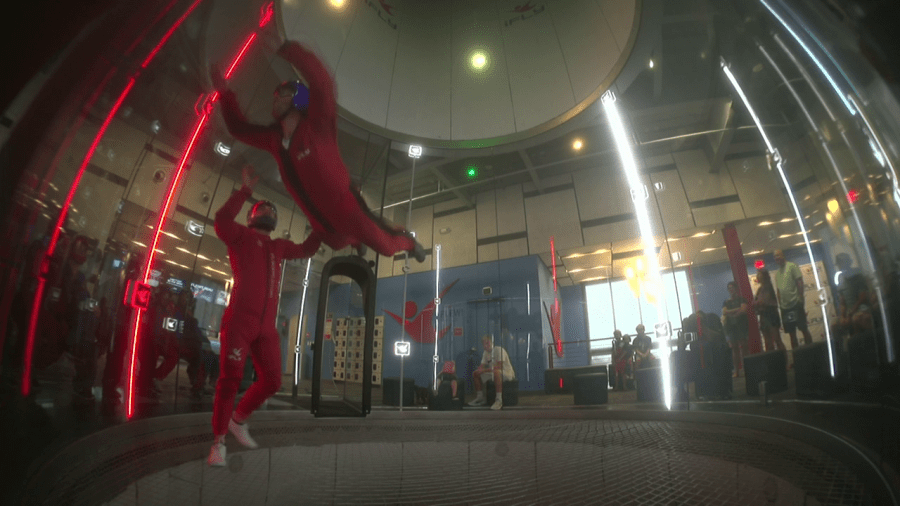
Working with Tyler again was great. It was fun this time; last time I was more focusing on the job to be done (practice, get a better arch), and being too serious. Once we got to playing the games, chasing him around the tube, it became fun and my flight in the tunnel flowed a lot better. We worked on docking at different levels, and did my first good leg turns in the wind tunnel, as well as practicing deployment wave and pulls. His help has made a big difference in my progression and help prepare me for what was to come later that day. After I was done, Tyler and 2 other instructors got in the tunnel and had some fun; it is really amazing watching what they can do in there, weaving in and out of each other upside down – wow.

The indoor fun was over, and it was time to head over to Skydive Spaceland Dallas to fall through the sky. I rolled in about 11:30, got my altimeter and got in the queue for a training jump. After a bit, Jocelyn ran me through my EPs (Emergency Procedures); I learn something every time I go through them. Everybody at the drop zone loves to skydive, that’s a given. Folks there like Daniel, Sara, Jocelyn, Bill, and Kris clearly love to share their love for the sport with others.

It took a while for enough plane loads to queue up for me to get my first jump in with Daniel (Level 5 jump). I’m getting better about keeping my chill on the ride up, but I still have some work to do to get in the right mental spot to get a clean exit. We moved up to the door, did a quick spot to make sure we didn’t have any air traffic or jumpers in our path. Then I swung outside the door, did my count, and we were off. I still felt the exit was a bit off, but a hard arch and we were oriented right and ready for moves. I had to do 360 degree upper body turns (using my arms). The first turn went pretty well, but my left 360 was loose because I didn’t keep my legs out. I tried to fly up to Daniel, but didn’t get there. He moved up to me, docked for my deployment. 6k feet came, then 5.5k and out goes the parachute.

My canopy ride down was great as always; I love my time under the canopy. Daniel said once I have my license I can do high pulls and get more canopy time as long as I clear it with the right folks. I got in a good pattern, and with some guidance over the radio, had my best landing yet. Less than 40 feet from the target, and a nice, soft, standing landing. I walked in with James (the other student on the jump); at least we weren’t walking across the drop zone/runway in 100+ degree heat!

Daniel walked through the jump with me; first thing he did was give me a high five over the good landing. We watched the video, went over what I did good and what needs improvement (legs!), and let me do the write up for the jump. While I called that a successful jump (I moved on to the next dive flow level), I wanted to try and get one more. So now, it was time to wait for a plane load to get scheduled and hopefully get another jump in. While waiting we had 2 more students come in.

Soon enough, tandems, students, and fun jumpers were loaded up on the Cessna Super Caravan for our trip up. Before long, we were at 13,500 feet and it was time to go. Fun jumpers and one student ahead of us went, then it was my turn. Oh yeah, I forgot to mention that Daniel told me this time I was going to be exiting on my own (he wasn’t going to be holding on to stabilize me). I asked “even though my last exit was a bit off?”, and his reply was “you gotta do it sooner or later”. Alrighty then. Again, 13.5k feet, and time to go. My turn came up quickly, and out the door I swung again. I did my exit count a little slower this time, and stepped off.

One second into it, I knew this felt right. I was watching the plane fly away from me and was not twisting out of the forward motion like I had in the past. This was my first ever clean exit I had experienced. Looking back at the video, there is plenty to critique and improve on. But It is a big improvement on my exits to that point; I’ll take it. Looking back at the video, I hear Daniel yell “_____ yeah” after my exit; that is my FAVORITE part of the jump, sharing a success with someone that has been helping me through this. I was also smiling during the free fall for the first time.

vlcsnap-2018-08-03-23h00m53s957

We then went into maneuvers. My first 360 degree lower body turn (leg turn) was a little loose, but still decent. My second 360 degree turn was cleaner. After that, I lost my leg posture and flew backwards away from Daniel without meaning to. I corrected, pushed my legs out a tad further, and then flew up to dock. A quick dock, my legs kicked back again, and I backed away. Daniel flew up beside me to watch my deployment and assist as necessary. He didn’t need to, it was a stable, clean deployment. I had just completed my first hands off free fall. I dare not say unassisted, because I wouldn’t have done it without my instructor at my side and the wind tunnel practice earlier.

vlcsnap-2018-08-03-23h02m26s981

vlcsnap-2018-08-03-23h03m54s169

After I had a good canopy above me, I did a quick celebratory yell, then got to work with my under canopy tasks. I needed to be doing riser turns. Risers are the heavy black straps from my shoulders up to my parachute lines. I needed to practice on pulling on them instead of my controls (toggles). This helps prepare me for the case where I need to steer with the risers in an emergency situation.

After all the work was done, I could do some fun turns. I love doing hard turns and swinging out from under the canopy, but it also causes me to lose altitude, so I get less air time when I do that. I lined up for my south approach, and realized that I hadn’t heard Daniel over the radio yet to guide me in. Radio silence all the way down, and while my landing wasn’t as good as the previous one of the day, it was still better than any of my other ones. I asked Daniel later about it, and he said the radio was working, he was just letting me land on my own.

Inside, first thing was a big high five from Daniel. He had the video queued up for me. I was actually smiling in this jump. All the other ones I had been so serious, but I was enjoying this one. Whether or not I enjoyed it was always up to me, but it has taken this long to get there. We talked over the jump, and yes there are still things to work on, but I think we were both stoked with how the jump had gone compared to previous ones. Several other instructors there were happy for me and enjoyed the progress along with me, high fives/hugs. Talking to Daniel, it looks like I can get a “big boy” helmet now (my own full face helmet of an approved brand/model); unfortunately they don’t have any $10 models for my $10 dollar head.

Jasmine said later watching the video and hearing Daniel, that she didn’t realize the instructors would enjoy/celebrate our progress so much. It is one of the many things that has made working past challenges enjoyable.

I know there are more challenges and more work to come; but getting this far has realized another one of my bucket list items – to skydive without being attached to another human being. I remember wanting to do this at least back as far as 2000, and I imagine longer; I bungee jumped in 1993 (what a disappointment). But my weight has always been in the way; 70 pounds of weight loss later, this has become reality.

The feeling of accomplishment is still there, but I already feel the “high” from that successful jump starting to fade. That doesn’t mean I am going to do “crazier” things, but it certainly means I’ll be back in the wind tunnel and drop zone to improve and continue my progression towards my skydiving license.

I had what it was like and what it would take to get to a hands off jump totally wrong in my head. Much like my trek to Everest was A LOT different that what my mind had built it up to be (different, but very much an experience of a lifetime). It is a weird feeling to get to 43 years old and thinking you’ve got things figured out pretty well; and then learning you really don’t know jack crap. If I did have stuff mostly figured out, life would be pretty sad and boring.

My final thought goes to the people that help along the way. For a lot of the things I’ve done in my life, I didn’t need a lot of help. I could research, work hard, and even will my way through it. That would never happen with this endeavour; however, it means that you get to share your triumphs with those that got you there, and they stay part of that moment forever.

Enough waxing philosophically: Videos!


Tired but Happy

I had a scheduled private training session at iFly for the morning, so I got things lined up for that. Coming off my last skydive where I didn’t advance to the next level, I wanted some time to work on my stability, arch, and control.

I got there a few minutes early, and my instructor Tyler was there waiting for me. It is really nice getting in there while it is not busy; that way fewer people see my wind tunnel fails 😉 I was geared up and ready to go in no time. First thing I learned was the proper way to enter the tunnel. Last time I was here (had 4 minutes total in the tunnel), I had just begun to learn moving forward and backward and didn’t figure out until after the fact that Tyler was trying to teach me to go up and down using my head position and amount of arch. I had more time to work on that now. I started with 6 minutes booked for the tunnel, but after that, I was like – “two more minutes”. I kept doing that until I was at 12 minutes total and other people had started to show up. By the end I was doing corkscrews turning as I went up. I don’t have turning while descending down just yet; I think that is because I’m more focused on the descent. It will come with time and practice.

Watching the videos it is clear I still have to work on my legs. My leg control is better, and I see glimpses of a good arch, but that darn left leg still goes nuts anytime I’m uncomfortable like when I get too close to the tube wall or feel the least bit out of control. I guess that is just something that I am going to have to continue to work on. Tyler is a good instructor and I like working with him; he’s always upbeat and supportive. And being an experienced skydiver with around 800 jumps, he knows what I’m looking to work on. After my 12 minutes were up, I went outside and looked up; seemed a little too cloudy to skydive, so I started the drive from Frisco back over to work. About 5 miles in, I decided to call the drop zone and see if students were jumping or if the clouds were getting in the way. They had a couple of students jumping, so it was game on! I exited the tollway, turned around and headed to the drop zone.

I got there and waited around a bit. That’s part of the game; you just need to chill and go with the flow as there are plenty of people needing attention, just not all about “you” :). Ultimately, Jocelyn came over and started running me through my Emergency Procedures. Jocelyn is definitely one of the instructors I like; she’s animated and doesn’t really use a filter – she says what she’s thinking. She went over the landing pattern with me, and then we got geared up for the jump.

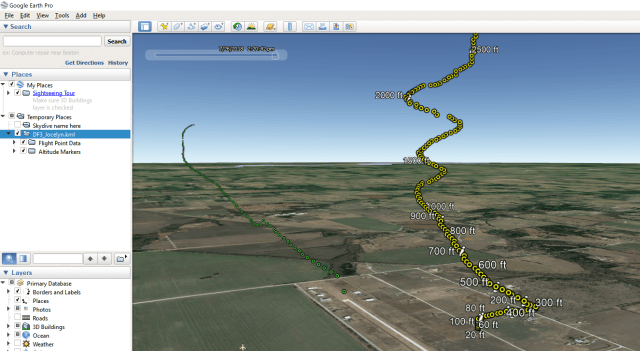
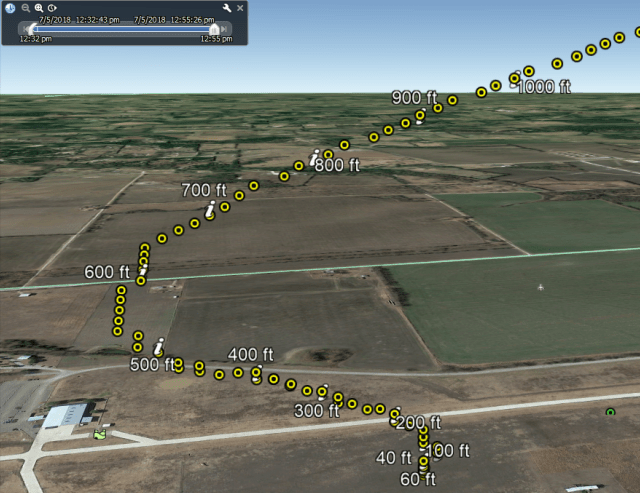
One of the good things about going in on weekdays is that it is less busy. A little more room on the plane on the way up, and fewer folks in the air to watch out for on the way down. I was definitely more chill on the ride up than I had been my previous jump. Doesn’t hurt that I had warmed up in the wind tunnel too. On the way up we did the standard altitude checks/quizzes. Jump altitude came up and it was time to go – 2 skydivers in front of us, then I gave my best tongue out crazy face, swung to the outside of the aircraft, did my count, and off we went. Things went ok, it always takes me a bit to stabilize. Jocelyn did let go of me for a short bit, she didn’t do a second release because I destabilized and moved backwards a bit. We got to 6k, I locked on and pulled as always by 5.5k; a few seconds later I knew I had a good parachute above me. I had a little more fun with turning, etc on the canopy ride down this time.  You can tell that from my flight track pictured below. Jocelyn let me do my flare completely by myself; she said she’d tell me to flare via the radio only if she thought I was waiting too long. I did my first 2/3 flare about 10 feet too early, then did the last 1/3 pretty close to on time. I had overshot a bit and was landing in tall grass. I ended up needing to do a roll on this landing; a stand up landing just wasn’t in the cards.

DF3_lower_canopy_portion
My “funnel” down to the landing site

Jocelyn went over the jump with me as we watched the video. I didn’t fully pass Dive flow 3, she put me on a modified level 3/4 jump. Basically, I could pass both on the next jump if I did well. Unfortunately, it was going to be over a 2 hour wait until the next plane. We needed to wait until the next group of tandem jumpers were in. It is understandable; they can’t put the plane up just for one person, that’s a money losing proposition. And if they lose money, they won’t be in business. If they aren’t in business, I can’t jump! I spent the next 2 hours chilling out for the most part. I almost slipped into a short nap on the bench in the student area while no one was watching.

Another student showed up just in time to do his emergency procedures, gear up, and get on the plane. He paired up with Jocelyn for this jump, and I paired up with Daniel, the lead instructor. Daniel had me do some practice arches. My legs still need work! We also did another check of my rig after it had been repacked. We caught a riser that had been put in twisted. It would not have caused anything critical, but you want everything perfect and clean as possible. That underscored to me that I should be checking my pack even if I sit there and watch the packer put the chute back in; I’m responsible for myself. We did some practice exits on the setups both inside and outside the hangar, then it was time to queue up and get on the plane.

We were going to be the first ones out of the plane on this jump; that was a first for me. I got the usual quizzing on the way up. We got to a little over 12k and it looked like we were going to get ready for our jump, but then the pilot started changing altitude. We needed some more room with the clouds. We ended up jumping at about 11.5k feet; this meant I’d have to get my tasks done with less time. First, I knelt by the door and spotted the drop zone with Daniel. Then I swung outside the plane, presented, did my count, and out we went. I felt us dip a little bit, arched hard, and it seemed to correct. Falling, we got stable, Daniel gave me the signal for a practice throw, which I did. He then released me and moved out in front of me. I was checking my altitude off an on as we continued to fall (of course); Daniel then gave me the signal to start my turns. I started with a right rotation, and ended up over doing it; I was only supposed to go 90 degrees, but ended up doing about 180. I did stop the turn however, and then returned back to point at my instructor. After that, we were about out of time, so he re-docked, I locked on at 6, and pulled my chute. Had a stable and controllable canopy above my head and all was good.

Daniel had said all things being equal (no real wind), he preferred us to do a north approach (remember, I had another student in the air with me who was on his level 4 jump). I saw the landing arrow slightly pointed south, so I set up for a south pattern. I really should have setup for north. Daniel saw the other student in the north, so he directed me over there via radio to get us in the same pattern. After that, I killed altitude till I was ready to start my pattern. I overshot again, but this time I at least landed on my feet. It’s hard getting good on target landings without a little wind to help slow your approach. That’s ok, I’ll get better with that over time.

We got back to the hanger, and Daniel went over the jump with me. The good news was I passed my level 4 dive, and was moving on to level 5. The bad news was that with the last minute change in airplane altitude, video didn’t get turned on. So I didn’t have any video of the jump. I also found out later, that I didn’t have video of the prior jump either (the wrong video got loaded in my folder, and I didn’t check it at the hanger (another lesson learned). I’ll take no videos and 2 level ups any day of the week.

Going into this day, I had 9 minutes of real free fall (including tandems) and 4 minutes of wind tunnel. Leaving the day, I had 11 minutes of real free fall, and 16 minutes of wind tunnel time total. That is pretty physically and mentally exhausting with the focus required, but well worth the results.

What I learned: chill out, don’t try to force things. I had been trying to apply this philosophy to my work during the week as well, and it appears to have had a positive influence. Taking a more laid back, go with the flow, let go attitude actually ended up with me getting more of what was on my to do list done. It seems when I was less stressed about interruptions and getting stuff done, I WAS getting more stuff done. I crossed off more in a couple of days than I have in quite a while. I hope that this trend continues. It is up to me to see that through. I’m just glad to see some progress on multiple fronts this week.

Here’s video of one of my wind tunnel sessions (we broke them up into 2 minute intervals):


Still More Work to Be Done

After giving up on jumping last Thursday due to winds, I decided to try and get out to Skydive Spaceland Dallas to get a jump or two in. I wanted to get up way before dawn and make the almost 2 hour dive and be there by 7:30. But I didn’t sleep well and decided it was better to get some more sleep and roll in a little later rather than jump with a couple hours sleep under my belt. I still made it there by 10 AM anyway.

I knew that it would be busier on a Sunday (why I try to get in a little work on the weekends so I can cut out for a good portion of the day during the week to jump), and it was. It took over 3 hours for me to get a turn to jump. During that time, I did get a chance to run through emergency procedures twice and get some tips for my next jump, and take in the busy hangar around me. I have to say it is nice to have such a large air conditioned building with a dedicated space for the students.

I finally got an instructor assignment and started working with my instructor. We also had another instructor observing her, so it would be my first three person jump, never had a person hanging off each side of me in the air until this jump. Other learning programs start with dual instructors, but not the STP (Skydiver Training Program). Every instructor is different. Some I connect with personality-wise better than others, but my job as a student is to take each experience and learn the unique things each instructor has to offer.

We practiced my form a bit. I’m still too tense when trying to hold my arch. My problem is that when I control my muscles, I get tense. There just isn’t getting to a position and holding that position AND relaxing. I’m sure it will come with time. I felt more nervous on this jump than others. I think part of it was that I was afraid I was going to “fail” the jump and not advance to the next level. I know from an outside view it is a bit ironic, but I was more scared of failing the jump than bouncing (because I knew that wasn’t going to happen). I think another part of it is I had gotten so much instruction on posture, that it was actually starting to have a negative impact.

Go time – I was seated at the front of the plane against the bulkhead. Normally, I’m a tad further towards the back because the tandem jumpers are the first on the aircraft and last off. It’s an interesting perspective watching the whole load of jumpers leave the aircraft and then following. You’ll see what I mean if you watch the video.

At the door, it felt a little different; it was my first time jumping solo(ish) out of the twin otter. I felt a little more scrunched up and was having a tough time getting out of the door. I don’t know if it was the plane or the way this instructor was holding me. Regardless, I did my count and stepped off the plane. I felt us nose into a dive for a half second, then we leveled out. The instructors immediately started giving me corrective hand signals (arch, legs, etc). I made the mistake of paying more attention to that than checking my altitude. So of course, I got a signal for that too! By time we were at 10k feet (falling from 14k feet), I was checking my altitude as should have been all the way down.

I never felt my instructor release me, and I was pretty much right. She told me on the ground later she let go of me for 1 second, and I saw that watching the video. Once I got to 6000 ft, I locked on to watch my altimeter, and pulled at 5500 on schedule. Got a good chute over my head, did my stability checks, and then started working my way over to the holding area. All went uneventful, and soon I had made another stand up landing (2 in a row) closer to the landing target than I had before. I still need to get closer, but I still liked seeing some progress there after my lackluster performance in free fall. It sure was hot walking back to the hangar in a jumpsuit with a parachute over my shoulder in 103 degree weather.

Back at the student area, I went over the video with both instructors. They dinged me on what I had already noticed (altitude awareness at first, stability, and posture). The instructor that had been holding on to me did the write up in my log book;  she explained to me that she didn’t advance me to the next level because it would set me up to fail on the next one. I completely appreciate that. I learned a few things due to her attention to detail that I didn’t pick up from previous instructors.

There were so many students on the board to jump that I decided to call it a day and not try to get a second jump in; I would have been waiting several hours for that. I can’t deny I felt bummed about leaving on a fail, but you have to learn from these things. Going into skydiving, I thought it would be all “jump out of the plane and bust a jump out”, but it is much harder than that. Part of my problem is I don’t like to fail. I get nervous about failure. And when I feel that, I push even harder to try and overcome and prevent failure. But that is just the wrong approach with this. You have to relax, try less. It is a pretty hard concept for me to accept, but I’m already making corrections to my daily life and outlook to try and bring that to bear.

I have also setup a training session in the wind tunnel this week. Getting only a minute of free fall at a time, it is easy to not learn the right posture and form for me. I just need more time to nail that down. And that’s where the tunnel is perfect. It’s a lot cheaper, and a lot more controlled environment. Then I gotta schedule another jump and say to heck with passing to the next level, I’m getting to jump out of a plane again – enjoy it!

And here is the video

Practice makes less imperfect….

After my last set of jumps July 5th, I began thinking of what I needed to do to work on my “lazy leg” issue. Basically, that’s what folks call it when you are not keeping your legs extended with a slight curve at the knees. I did some practice at home best I could, but it just doesn’t reflect the environment this really needs to happen in.

So I decided to take a trip over the the IFLY wind tunnel over in Frisco. I think some skydivers have varying opinions on wind tunnels; it is place to practice, but also a place to pick up bad habits if you aren’t instructed by someone who knows skydiving too.

After I first arrived, checked in, and went upstairs, I just sat down and watched the session that was going on. The first question I had for myself was… am I too tall for this ride?

am_i_too_tall_for_this_ride
Am I too tall for this ride?

Talking to skydivers who were doing wind tunnels 10 years ago, today they (wind tunnels) have become more of a entertainment item. You have to look at it from the perspective that making it a more common experience (beyond training for skydivers) results in more wind tunnels and makes them accessible. The skydiver I talked with that had done this 10 years ago had to go to Arizona for wind tunnel time. I just had to hit the tollway and head over to Frisco.

windtunnel_and_i
Selfie with the wind tunnel

We ended up with a group of 12 “flyers” for our wind tunnel session. We lined up on a bench outside the wind tunnel and waited our turn. We each got 2 turns, with most people getting 1 minute turns. I had 2 minute turns because I had paid for a total of 4 minutes. The wind tunnel instructor I ended up with (Tyler, who is also a skydiver) was excellent. He tailored my session towards working on my form/techniques over a “fun” time.

It is a bit weird leaning out of the door into the wind tunnel to enter a horizontal position, in a split second you have completely changed your orientation to ground. There are a couple of big differences between the air tunnel and the real thing. One, you don’t have the adrenaline from the ride up and getting ready to step out. This does keep you more calm so you can work on technique in the tunnel. There is also the obvious “safety net” of the fact you aren’t heading towards terra at 120 MPH. You do, however, need to stay aware of the walls. When in free fall, you aren’t going to bump into anything (other than another jumper if both of you aren’t paying attention) if you drift one way or the other.  You honestly don’t really even notice it (not at my level anyway). But in the tunnel, you are very aware of the walls around you. It didn’t take long for me to find one of the walls. As soon as I bumped it, I got loose with my legs.

My legs are what I was really there to work on. I felt I had done a lot better in the wind tunnel form wise, but watching the video after the fact, I saw that I still have a good bit to work on. Jasmine pointed out that anytime I get uncomfortable, like when the instructor grabbed me to move me to the door at the end of the first session,  I start “swimming”. My legs get loose, I start kicking, etc. If you watch the video of my first attempt at dive flow 2, you see the same thing. When the wind kicked me around, I started kicking. I guess that is a natural psychological response. I’ve spent 43 years using my legs as my primary tool to change my position, move, etc in respect to the earth. Now in flight, they are just one piece of the puzzle. I know I’ll get there, but it will take some worth to change those years of habits.

My second session, Tyler worked on some movement items with me. He was teaching me how to change my body position to move forward and backwards. Of course, I’m still doing those motions quick and jerky, rather than slow and fluid. It does make a difference. Check. Something else to work on.

I waited until everyone else had returned their gear and spent some time talking to Tyler afterwards. One thing about this sport I like is that there are a lot of friendly people involved. Sure, there are some curmudgeons, like there are in any thing you do or anywhere you visit. But overall, I still feel like fellow skydivers have a different take on life and their outer self reflects that.

Tyler also does private instruction, and it is $2 more per minute that regular, and you have the wind tunnel to yourself. I will be doing that in the future. I just have to figure out how to mix that in my already hectic schedule that I’m trying to fit in. I think it is worth the extra practice, especially once I start getting to jumps where I am doing “gymnastics” in free fall. I’ve got to do barrel rolls, front flips, and back flips before I can graduate. I think practicing those in the tunnel will pay off and help increase my chances of getting right the first time. And wind tunnel time is way cheaper than what it costs for a minute of free fall when jumping out of a plane. Speaking of, I’m sitting here at Skydive Spaceland Dallas, playing the waiting game with the wind.

wind0719
Please wind… let me jump!

Here’s my videos from the wind tunnel. Definitely worth doing.


The Joy of Twisting Tech to Your Needs

I was barely past my first tandem jump when I looked at my Garmin watch (Vivoactive HR) and thought, “I should be able to use this to log my skydives”. After all, it has a GPS and built in heart rate sensor (you don’t need to wear an extra heart rate sensor/strap). My first jump my instructor told me to pull the watch, but I wore it for my second tandem jump and thereafter. I figured I could be safe with my watch double latched and under my jump suit.

The first time I tried to use my watch, I accidentally put it in “rowing” mode instead of running. I got heart rate and location data, but NO elevation data – bummer. Even that was pretty cool for me to look at and see an overhead, flat earth view of the path.

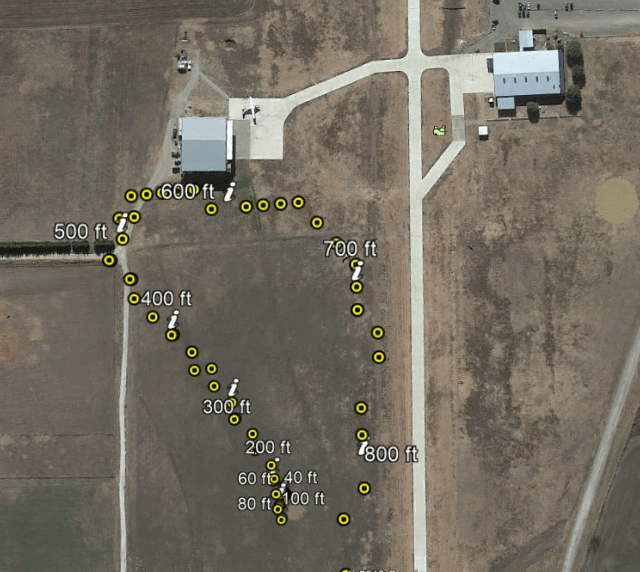
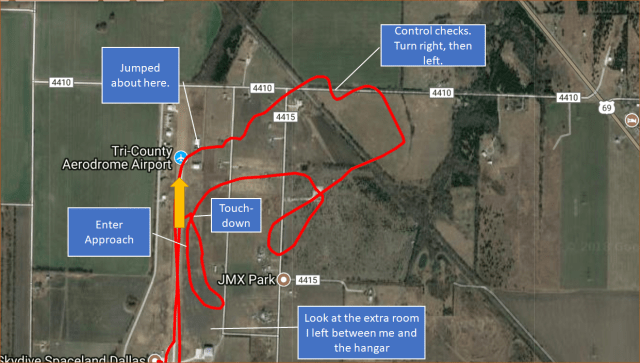
But I learned my lesson. My first training jump (solo, but with instructor holding on to me), I put my watch into “running” workout mode. I got my elevation data. I pulled the standard KML file for the “exercise activity” from my Garmin account; KML, or Keyhole Markup Language, is the format that Google Earth (GE) uses to represent geospatial data. It is a pretty common standard these days and used in more than just GE. Even with the elevation data, the track was snapped down to the earth surface, not giving me a good view of what my flight path really looked like. I did a quick “monkey patch” of the KML file to try and get elevation used for display of the flight path. A “monkey patch” is when you hand edit a file or piece of data to get what you want; it is pretty blunt force, but it does get the job done and is perfect when you are prototyping and digitally exploring. My monkey patch worked – I was on the road to being happy. My very first training jump, I overshot my landing spot by more than I was wanting. Reviewing the track in GE made it very clear why. I had turned way too early on  approach. I realized that I was not looking straight down between my feet for my turn point, but rather ahead at an angle. This was already paying off.

original_garmin_export
Original export, flat on the earth (What running flies, after all)
monkey_patched_ge
Monkey patched version, now I can view in 3D with elevation

The next thing was to automate the process, as having to do it by hand every time would be a PITA. So I started with writing a program to parse the positions (with their timestamps) out of the original KML file. Once that was done, I wrote an output generator to build a more friendly KML file to view in GE. At this point, you might be thinking “So what, you already had that with your monkey patch”. This was just getting the basic gozintas and gozoutas setup (data in and data out – some slang I picked up from one of the many grumpy experienced programmers I’ve had the fortune to learn from on my way to being a grumpy programmer).

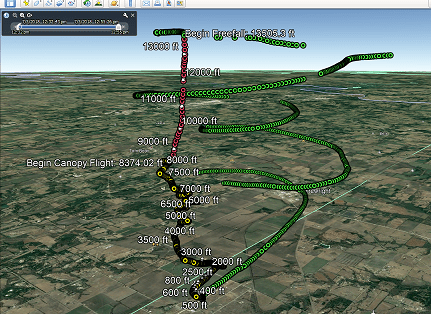
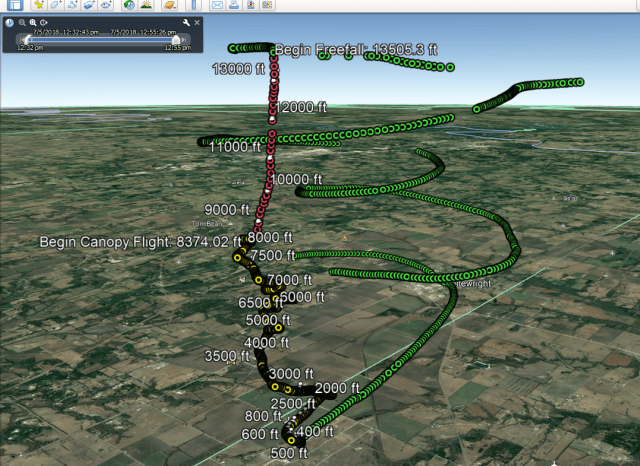
It was now time to do some data processing. First, I was putting my watch in exercise mode long before I ever queued up to get on the plane and well after the jump was done because you shouldn’t let things distract you when it is go time. So I have all these points before and after the jump that are pretty useless. I wrote a crude filter to cut these out. Then I expanded on the filter to use elevation and vertical change to detect: ascent in the airplane, free fall, canopy flight, and finally, my return to terra firma. Then it was time to snazzy up the output. Based on the phase of the jump, I color coded the track: green for ascent, red for free fall, and yellow for canopy flight. I added some altitude annotations (when I went from one phase to another, as well as altitude at intervals).

final_version

zoom_in_final
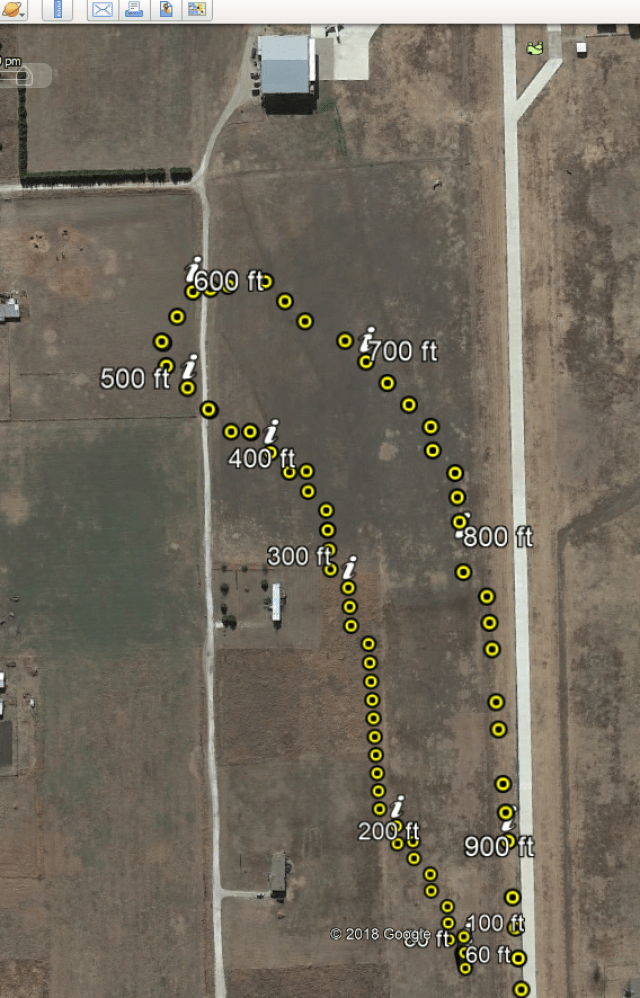
Zoomed in version of my final approach


first_landing_overshoot
My first landing, a bit of an overshoot, but at least I stayed on the property!
top_down_final
My best landing yet.

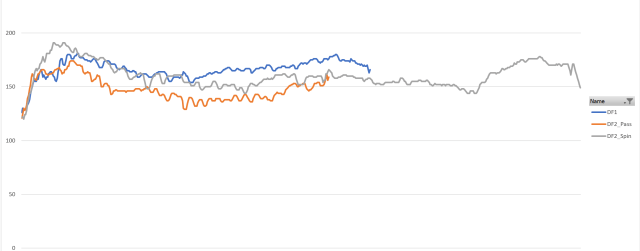
I realized I could use a different file format exported from my Garmin account that included heart rate data, so I wrote a new parser to read the new file type. I was pleased with being able to export the data to a csv file, then importing it into excel. Maybe in the future I’ll build a graph generator/display directly in the application.

heartratedata_jumps
Blue was my heart rate from first training jump, silver my “spinning” jump, and orange is when I passed my Dive Flow 2 jump. There is more heart rate data for the spinning jump (silver)  because it was a longer flight (I pulled early). I’ll be interested to see what my heart rate looks like after I am a more seasoned sky diver.

All this from a $170 watch meant as an exercise/activity tracker for runners. There are turn-key solutions already out there, but they are much more expensive, and I have to take what I get in terms of features and capability. We’ll see where it goes from here. I’m already adding functionality to store the jump information to a database so I can retrieve it later, as well as adding notes for each jump. Turning it into an electronic logbook for skydives. Again, these already exist, but this one is all my own. I see some algorithms to extract additional data in the cards as well; I just need to find more time.


It’s a great feeling to be able to use technology and a bit of code to solve real world problems. I always suggest to folks that they should learn a little bit of programming, even if it is just writing some fancy macros for excel. I promise it will pay off.

Try, Try, and Try Again (Dive Flow 2)

I decided to go skydiving the day after the 4th of July holiday. I thought it might be a good day to go (weekdays are less crowded), but it seemed plenty of other people were also thinking the same thing. I got in about 8:15, and as a result I missed my first chance at running through Emergency Procedures (EPs). It is just tough getting up early enough to make the 1:45 or better drive and be there by opening time.

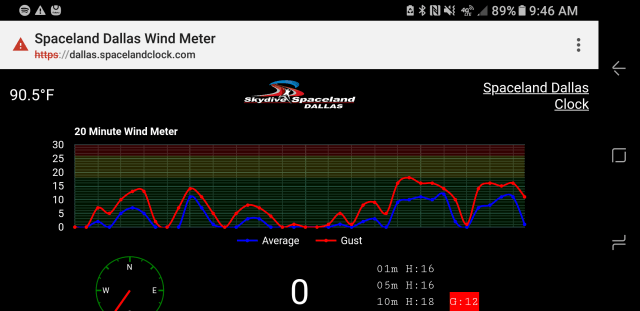
I got to run through my EPs a little later with 2 other students, then get in line for my turn to do my Level 2 (of 18) jump. Bill (the same instructor from my previous jump) was my instructor for the next one. I’m not adamant about using the same instructor; I figure that working with several gives me a chance to see different variations of techniques and find out what works best for me. Bill is a great instructor, so I was happy to pair up with him again. We ran through the check on my pack to make sure everything was good (of course it was). I got geared up and waited my turn to get on the plane. All of my jumps have been out of the single engine Cessna Supervan they have, I do wonder what it will be like solo jumping out of the twin engine Super Otter (will the prop wash be noticeable at speed).

Bill did his normal routine of quizzing me about procedures and altitudes on the way up. We got to jump altitude and waited our turn. Before I knew it, it was my turn to swing to the outside of the door, get my “go shake” (Bill shakes me to let me know he’s ready so I don’t have to turn my head to look at him in the door), and step out. This jump seemed different; I was having more trouble with keeping my body stable than my first non-tandem jump. I needed to get stable so I could do my tasks for this jump, which were to use my arms to turn 180 degrees right and then back 180 degrees left during free fall. While still trying to get good and stable, my altimeter came off a the wrist; the only thing holding on was the loop that goes around my finger. I reached over with my right hand, grabbed the altimeter, and placed it into my left hand so I could hold it and actually read the numbers. The rule is that if you don’t know what altitude you are at, you are to pop your chute immediately, so getting the altimeter back into a state where I could read it was top priority. After that I never did get stable enough to do my turns. As I had started my wave to signal I was deploying my parachute, bill signaled to “pull”, so it was good timing.

While the free fall was essentially a failure (I didn’t get my turns done), my flight under canopy went well. I did my brake turn practice as required for this dive flow, and lined up for a decent pattern. I tried to land standing up, but didn’t quite time it right, so I ended up doing my standard parachute landing fall (PLF) to spread the impact out. Back in the hangar, Bill went over my video and told me the biggest issue was me not arching enough.

Things picked up at the drop zone (more students showed up), so Bill ended up handing me off to Cody. Cody is actually an employee of Skydive Spaceland Houston, but he was in town after the holiday and decided to show up and see if he help out. I’m glad he did – he spread the load out and let more students get handled in a more timely manner.  Cody with through the pack checkout with me again, and we got ready to jump. Bill was on the same plane with a jumper that needed to re-certify (If you go too long between jumps, you have to re-certify with a licensed instructor). This time I made darn sure that the altimeter was well fastened, using a rubber band to further secure the velcro closure. It came time, and off we went.

Things never were quite right when we jumped, I was even more unstable than before. I kept trying to adjust my body position, and it just kept getting worse. It was not long until Cody and I were spinning upside down. If you think about the shape we formed with Cody hanging off the side of me, we made a “T”, and the spin was basically like someone had thrown a hammer. Ultimately, the spin got so strong that Cody had to let me go. At that point, my mind was going through what I needed to do (at least I wasn’t freaking out!). A big rule is that if you lose your instructor, you pull your chute. However, you need to be stable to get a good parachute deployment. If I pulled while spinning upside down, I was pretty much guaranteed I’d have a “big ball of crap” over my head, and would be likely to have to cut my main chute away and go to reserve. So I decided to give myself a few seconds to try and get things worked out. One thing in training they tell you is that if you arch, things will self correct. That’s exactly what I did, and within the matter of a few seconds I was face to earth and stable and I deployed my main chute immediately. I never was really what you would call scared. Was I aware of the situation, and concerned with finding a resolution? Dang right I was. Fear is there to help keep you from getting in a situation, but once you are in it, fear doesn’t provide any benefit other than to distract you.

After I saw I had a good canopy overhead, I went to my tasks of making sure I had a good steerable canopy. This is something you do every time after you open your chute. You flare, steer right, steer left, and flare (brake) again. After that, you know if you have a controllable canopy. Since I had pulled early (sooner than the normal 60 seconds of free fall), I had a longer float time down to the ground. I won’t deny I enjoyed the extra time. Honestly, flying under the canopy might just be better than the free fall as you have a little more time to enjoy the view. My landing was better than the last, it was actually very close to the target. I did end up doing a fall again (PLF) instead of standing the landing. Cody didn’t beat me up about what happened. We talked about how it could be avoided, but while not happy about the failed free fall (I clearly didn’t get my tasks done). However, he seemed happy that I was able to correct the spin and deploy. I later heard him telling other instructors outside (he didn’t see me) that he had to let go of a student for the first time ever today, but the student knew what to do and did it.

The major factor that caused the spin was my not exiting the aircraft properly. I was not arched enough, and did not exit facing squarely forward. As a result, it started us into the spin that soon became unrecoverable when coupled with my poor arch.

There was quite a delay for my next jump. I know you might be thinking: “Dude, you just had a bad jump, and you are going back for more?”. Here’s the thing: I didn’t want to leave for the day having been beaten. Was I a little concerned? Sure, a little. But I had just proven to myself that I could handle it when things go wrong. Don’t get me wrong; It would have been better to not get in that situation, and I certainly don’t need to get over confident or complacent. But it is also a confidence builder to know you handled it.

After winds calmed down and I got on another jump load, we were good to go. Load time came, and Cody and I were back on the plane. I was thinking through what I needed to do. I knew I needed to present better holding on to the plane while hanging outside getting ready to jump. I also knew I needed to arch. We exited the plane and I immediately knew things were better. I felt a slight twist coming off the plane, but it corrected almost immediately and we were in stable free fall. Now the real work began. It took a bit to get my posture right; Cody kept telling me to correct my leg positioning. Basically, they should be at about a 45 degree angle at the knees. Falling through the air, it’s tough for me to gauge the right position and KEEP them there. I got close enough and I got the thumbs up from Cody. My first job was to do 2 practice touches to prove that I knew where the handle was for the pilot chute. Another leg position correction, and then I was doing my free fall turns. When done, I was past my altitude to end turns by 400 feet (I was supposed to stop at 7000). When you are falling 1000 feet every 5.5 seconds, it doesn’t take long to cover that extra 400 I had. I shook my head to indicate I was done turning, locked on to my altimeter, and pulled at 5500 feet as planned.

After I knew I was under a good canopy, I did a little shout; I finally got this right and I knew I would pass my Level 2 jump as long as I didn’t botch the landing. Flight down went good. I was running a little short on distance, so I didn’t get into my holding pattern and do an “L” approach. I basically went straight into my final approach. I came up a little short of the target, but I was well within the bounds of the landing area. Most importantly, I pulled off a standing landing this time. Cody was cheering over the radio. While I had not mentioned it prior, we have a radio on us that lets the instructor guide us in for the approach and help us time our flare. The flare is when we trade forward motion to reduce our drop speed.

I got my chute bundled up, and walked back to the hangar a happy camper. I hung out several hours after that hoping to get my Level 3 jump in, but it never happened. Our wind speed limit as students is 16 MPH. If the wind spikes over that, even once, we have to wait 20 minutes with no more spikes over 16 MPH. After about 2 hours, I called it and went home. But not before saying goodbye to Cody. He was an awesome instructor. Instead of letting me get down about my issues with the jumps, he was upbeat and kept motivating me to improve and get the next jump in. I’d definitely jump with him again. I also thanked Jenna, the chute packer that had repacked my parachute after my jumps. You have to be thankful for the person taking their time to pack that parachute right. Every opening I had was a clean one.

On the ride home, I spent some time thinking about the jumps. I think a lot of my problem is that I was so focused on correcting previous issues (arm position, etc) that I let it tense me up and cause problems else where. I’ll be practicing my arch at home and getting ready for when I do get that Level 3 jump in. I also walked away feeling as if my 2 fails at the Level 2 jump were not a complete loss. I learned some things as a result, not the least of which is that I feel I can trust myself to keep my wits and try to work through high pressure issues in the air. It also felt good to not have let those 2 bad jumps send me home packing. Getting on my steep pitched roof (I had to do that today to clear out my clothes dryer vent) makes me more nervous than jumping out of a perfectly good airplane. Don’t get me wrong – I don’t have it all figured out. Not even close. I have so much to learn it isn’t funny. But that is part of what makes this experience fun for me – there is so much new information from a domain I know nothing about. Refreshing!

I’ll have a post soon showing how I’m adapting some technology to help me with my learning. Basically taking devices meant for other sports and adapting them to get some useful data in the skydiving domain, without having to pay big money for specialized tech.

So here’s the videos. Don’t let the spinning video freak you out. It clearly all ended well.

Dive Flow 2 Failure #1, Unstable and had my altimeter come loose. Also notice my instructor had to deal with line twists on his deployment.

Dive Flow 2 Failure #2: THE BIG SPIN. You can quit watching after 50 seconds or so; I need to upload a trimmed down video.

Dive Flow 3 – FINALLY!

My first (assisted) solo jump

I got my ground school in last Sunday, but it was too windy after class finished for students to jump (We aren’t allowed to jump if the wind is over 16 MPH). So I wedged a little time out of my schedule and made it over to Skydive Spaceland when it looked like I had a decent weather window.

Before jumping I had to run through my EPs (Emergency Procedures). Last year was the first year that failure to execute EPs properly was the leading cause of skydiving deaths. Previous years have been collisions according to my ground school instructor. As such, EPs are getting extra focus.

Since I touched on the whole “death” thing, let’s go ahead and get it out of the way. Yes, jumping out of a perfectly good airplane carries some risk. In 2017, there were 14 fatalities out of 3.2 million skydives. Some would argue (and have provided stats) that driving a car is more risky than skydiving (How bout we look at statistics regarding Tesla auto-pilot fatalities…). Of course, you have now entered the twilight zone of lies, damn lies, and statistics; everyone likes to try and flex their grey matter muscle on the subject to make their view “right”. In both categories (skydivers/drivers), you are lumping all participants together, which is a basic logic fault. Should a driver who always drives with their seat belt on, doesn’t text and drive, never drinks, and stays off the road at late hours be considered equally at risk compared to someone who drives in the opposite manner? The same thing goes for skydivers; some have better habits than others. I guess I have tried to flex my grey matter too – oops. In the end, complacency is the enemy for both.

When you get down to it, rip away all those numbers (it begins to feel like a Salvidor Dali painting with equations) and decide how you want to LIVE your life. For me, marking time in fear of death and playing everything safe isn’t living at all. I’ve given the good lord plenty of chances (four wheels, two wheels, one wheel, hiking on the side of a mountain, you name it) to pluck me from this earth and he has chosen to leave me here for some unfinished business I’ve yet to realize. I’ve seen him call home others who I did not think were done here on earth as well; you can’t question that for which you don’t have the complete view. So, I’m choosing to live in the what is and not in fear of the what could be. Please appreciate my choice even if you don’t agree with it. End of soapbox.

After practicing Emergency Procedures, we went outside to watch the current load of jumpers to float back in, specifically watching the student jumper land in the area allocated to students/A license jumpers. The student we were watching land was actually a guy who had sat behind me in class. Everything seemed to be going well, and then he started making hard course adjustments on his final leg of the approach. You shouldn’t be steering much at all as you near the ground (other than avoiding a collision) because it increases your downward speed. I could hear the instructor yelling over the radio to QUIT TURNING. The student was trying to avoid going into a heavy grassed, unmowed area. Once he made one turn, he turned again to correct that one, and things just spiraled beyond what was safe. As hard as he came down, I was really concerned he was hurt. I was glad to see him walk back into the hangar under his own steam. I made a mental note for my landing.

I waited for my turn with the instructor; I ended up with Bill. I really liked his easy going attitude (think of the attitude of a surfer); not all instructor personalities are equivalent. Bill went over my landing pattern, graded my pre-test, and went over the gear checkout with me. We were then quickly loaded onto the Cessna Supervan with 2 tandems, another student (she was on jump #14), and a couple of licensed folks. Of course I was nervous; hard not to be. I even entertained the thought of chickening out and riding the plane back down (and then told myself heck no). The experienced folks did hop and pops (jump at low altitude with very little free fall). Again, as we readying for jumps, high fives and fist bumps were flying; the skydiving club was celebrating. This is my 3rd favorite part of the experience (#1 is free fall, #2 is floating under the canopy). We got to altitude (12k feet vs 14k due to clouds) and the more experienced student went first, then I was up. I didn’t have any real hangup on jumping out of the plane; I just wanted to make sure and watch the plane fall away. On my 2 tandems I was on such a sensory overload that I don’t even remember seeing the plane fly away as I fell away. I saw it this time 🙂

Free fall: I only had 3 jobs for the free fall portion. (1) Proper body position (ARCH!!) (2) Do three practice throws so I knew where the hackey (what they call the pilot chute handle) was when it was time to actually pull. (3) Lock gaze on my altimeter at 6000 feet and pop the main chute at 5500. Bill made several corrections to my form (arm position, arch, leg/feet position) during the fall.  I pulled at nearly dead on 5500 feet. No issues with the deployment; I had a good main canopy above me. Now the only task left was to get to the holding area, float down, and get in a good landing pattern. It really was nice being up there with the wind blowing past me in the solitude; it reminded me a bit of parasailing, but I actually was steering this rig. As I got closer to time to go on approach, Bill was on the radio with me; I wasn’t alone in this!


solojump_elevation_vs_heartrate
Elevation (green) vs. Heart-rate (grey). Funny, my pulse spiked up to 180 as my elevation spiked down. My resting pulse is in the high 50’s.

I entered the pattern a bit high (maybe 1000 feet instead of 900). Couple that with the fact I turned before I had to (we aren’t supposed to get over a structure on our cross turn and final turn). The aircraft hangar looked a lot closer than it really was after I reviewed my recorded path (I’m using my Garmin GPS watch to log my track). I will remember that for next time. The main thing is I dang sure wasn’t going to get turn happy after what I had watched an hour earlier. I made small adjustments to stay between the thick grass boundary and the runway; I overshot the landing target by a good bit, and started my landing flare a bit early. I also tried to make a standing landing, but with the speed ended up doing a butt landing (probably should have done a PLF – Parachute Landing Fall – instead). All in all the landing could have been better, but I made it. If you were golfing, you would say I hit the edge of the green; I wasn’t in the woods, hanging from a powerline or a tree.

solojump

They came and picked me up with the golf cart. After dropping my gear, I went over the video of my jump with Bill. He called out the things I needed to work on, but he didn’t beat me up. He said I had very good altitude awareness. I guess if I want to get one thing right, knowing my distance to earth would be it! Talked with some of the other students for a while (had a couple there from Alaska – my favorite non Lone Star state). Got my logbook signed and filled out, and training jump #1 was officially in the books.

Driving back to work, I couldn’t help smiling. At least for now, skydiving is my “therapy”; it forces me to focus on the right now with such intensity that all the other crap just melts away. With all the stresses of normal life (work, etc), I need a hard reset like this; it lets me start with a fresh attitude. It’s also helping me learn some things about life (if a mangy old dog like me can learn any new tricks at this point):

  • You don’t have to get everything perfect.
    • That’s tough for a die hard computer guy to say. I have “BINARY” on my license plates for goodness sake (black or white, no grey area).
    • Yet I didn’t have perfect form, didn’t nail my landing, and everything was still a success.
  • It’s OK to have fear
    • We are pre-loaded with basic fear instincts. But you can confront and manage it (I really did consider chickening out). I was more scared of screwing up the landing and looking foolish than scared of the jump (sad).
  • Watch and learn from others
    • There’s a lot of things to pick up in the training area watching instructors go over training videos with students, etc.
  • Appreciate the differences in others
    • Most the people working at the drop zone are die hard and live much different than what a lot of us know
    • Many of them left college, quit the jobs they knew, or gave up businesses to follow the jumpers life; you have to admire the level of commitment required.

Without further ado, here is the training video from my first jump

Back for a second jump

Jasmine said when we bought the next jump for us that I didn’t have to wait on her since I wanted to get on with working towards my skydiving license (after your second tandem jump, you can start the training program at Skydive Spaceland Dallas with a class followed by solo jumps under supervision). Well, let’s just say I took her up on it and did my second jump the next day.

I was hoping to get in when they opened up at 7:30, but ended delaying a bit to see how the clouds were going to pan out. I was still gun shy because of the first day we tried to jump and walked away with rain checks thanks to the weather. I ended up getting there about 8:15 and got in the queue for jumps. We were actually having the opposite problem of the previous day; not enough people. They put the jump on a 20 minute hold because there were not enough jumpers for the next load yet. Then some clouds came through that put us on hold.

I met Sara, my instructor for my second jump. She was awesome to work with. Since we were on the delays, she came over and introduced herself and started walking me through all the things we were going to do on the second jump. We spend a lot of time talking about the procedure and flow of the jump trying and retrying the form of moves as needed. I was going to:

  • Do the count for jumping out of the plane
  • Control a 360 degree turn to the right during free fall
  • Control a 360 degree turn to the left during free fall
  • Track (tuck my arms in at my side and straighten my legs for speed) for 5 seconds
  • All while staying aware of altitude and pulling the ripcord at 6,000 feet.

The first time we jumped, the instructor had us sit on the floor of the plane at the door and basically rolled us out. This time we were standing at the door. The instructor mirrored my movements as I swung my body out the door to be standing hanging out of the plane. Then you do a 3 count while holding on with your right arm. Left arm out, left arm in, left arm back out, release and step/fall away.

We loaded up, and took off – I got my ride on the Twin Otter this time! On the way up, we were on with another tandem pair, a few solos, but the rest was a team or organized group. I managed to turn on my fitness logger to try and record my track down. Most of the way up people were quiet, reflecting on their jump flows that they were going to execute. As jumping altitude neared, things lightened up and high-fives and fist bumps were going on all over the plane. One of the jumpers was giving me friendly advice on being sure to look up and focus on the plane’s wing as I jumped. The friendly atmosphere really reminded me of the mountaineers I was lucky enough to hang around with on the way to Everest Base Camp.

It was definitely different jumping this time with a “job to do”. Last time I was pretty much along for the ride other than pulling the rip cord. It seemed like a lot to do in the 60 to 120 seconds I was free falling. Before I knew it, the free fall portion was over and we were floating down. Sara walked me through turns with the canopy. We even edged through a cloud that got in our way ;).


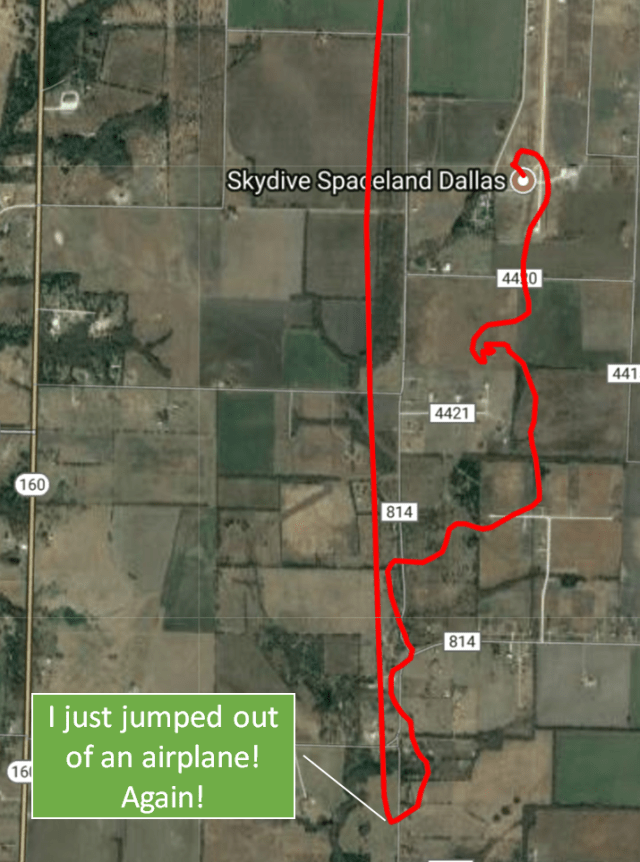
skydive_tracks
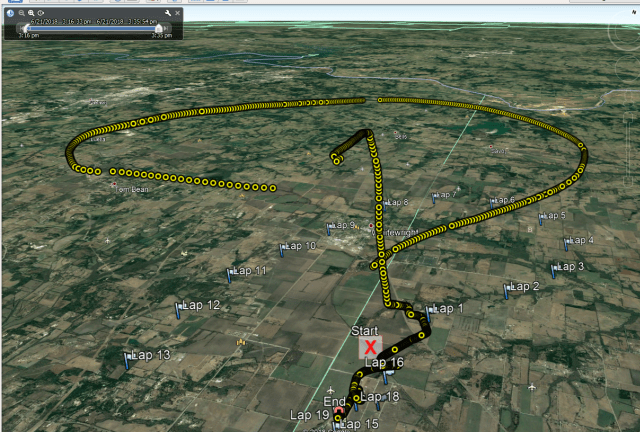
My GPS logged jump

After we landed, we went over how to pick up the chute and get it back into the building without tearing it up, and how to lay it down for re-packing. Then she went over the jump, calling out the things I could have done a little better as well as what I got right. Sara didn’t beat me up (saying most first timers do the things i did), but she also was straight up about the technical aspects, asking how I thought I did at various portions. Again, I was fortunate to have such a great instructor for this jump; I walked away knowing this is something I want to pursue.

Next, I’m taking a 6 hour class and will be ready for my first solo (the instructor is holding on to you in free fall to keep you stable).

P.S. Sorry no pictures, I didn’t have photographer Aaron with me this time, and the photo/video packages were out of my budget range; you’ll just have to deal with my Info-graphics 🙂

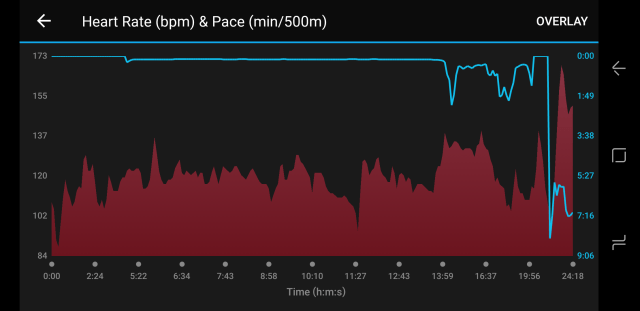
pulse and speed
Blue line is my horizontal ground speed (tops out about 120 MPH) and red is my pulse rate. Any guesses where I jumped out of the plane? Just FYI, my resting pulse is around 60bpm