I got my ground school in last Sunday, but it was too windy after class finished for students to jump (We aren’t allowed to jump if the wind is over 16 MPH). So I wedged a little time out of my schedule and made it over to Skydive Spaceland when it looked like I had a decent weather window.
Before jumping I had to run through my EPs (Emergency Procedures). Last year was the first year that failure to execute EPs properly was the leading cause of skydiving deaths. Previous years have been collisions according to my ground school instructor. As such, EPs are getting extra focus.
Since I touched on the whole “death” thing, let’s go ahead and get it out of the way. Yes, jumping out of a perfectly good airplane carries some risk. In 2017, there were 14 fatalities out of 3.2 million skydives. Some would argue (and have provided stats) that driving a car is more risky than skydiving (How bout we look at statistics regarding Tesla auto-pilot fatalities…). Of course, you have now entered the twilight zone of lies, damn lies, and statistics; everyone likes to try and flex their grey matter muscle on the subject to make their view “right”. In both categories (skydivers/drivers), you are lumping all participants together, which is a basic logic fault. Should a driver who always drives with their seat belt on, doesn’t text and drive, never drinks, and stays off the road at late hours be considered equally at risk compared to someone who drives in the opposite manner? The same thing goes for skydivers; some have better habits than others. I guess I have tried to flex my grey matter too – oops. In the end, complacency is the enemy for both.
When you get down to it, rip away all those numbers (it begins to feel like a Salvidor Dali painting with equations) and decide how you want to LIVE your life. For me, marking time in fear of death and playing everything safe isn’t living at all. I’ve given the good lord plenty of chances (four wheels, two wheels, one wheel, hiking on the side of a mountain, you name it) to pluck me from this earth and he has chosen to leave me here for some unfinished business I’ve yet to realize. I’ve seen him call home others who I did not think were done here on earth as well; you can’t question that for which you don’t have the complete view. So, I’m choosing to live in the what is and not in fear of the what could be. Please appreciate my choice even if you don’t agree with it. End of soapbox.
After practicing Emergency Procedures, we went outside to watch the current load of jumpers to float back in, specifically watching the student jumper land in the area allocated to students/A license jumpers. The student we were watching land was actually a guy who had sat behind me in class. Everything seemed to be going well, and then he started making hard course adjustments on his final leg of the approach. You shouldn’t be steering much at all as you near the ground (other than avoiding a collision) because it increases your downward speed. I could hear the instructor yelling over the radio to QUIT TURNING. The student was trying to avoid going into a heavy grassed, unmowed area. Once he made one turn, he turned again to correct that one, and things just spiraled beyond what was safe. As hard as he came down, I was really concerned he was hurt. I was glad to see him walk back into the hangar under his own steam. I made a mental note for my landing.
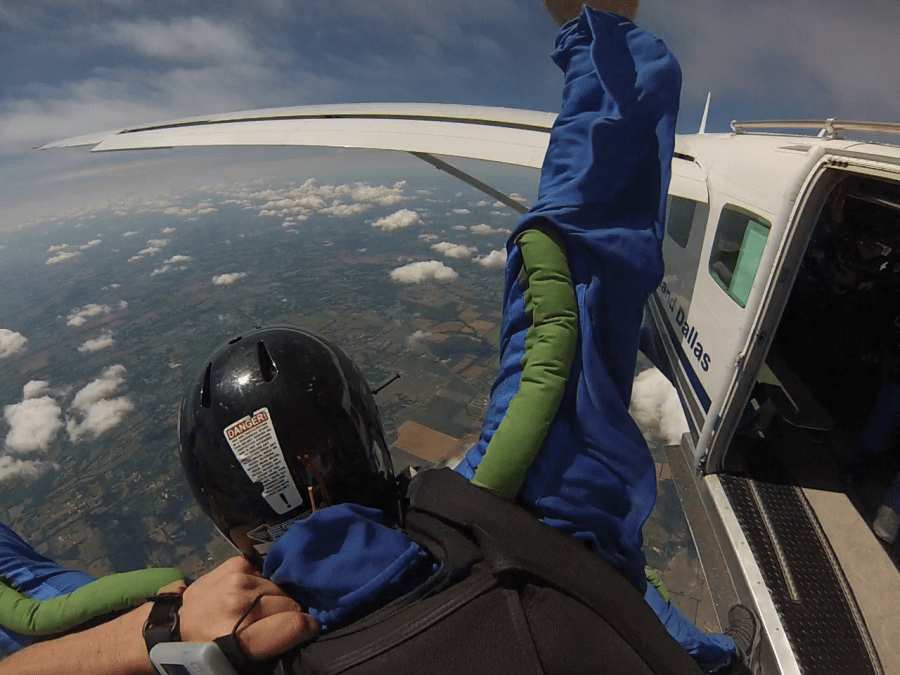
I waited for my turn with the instructor; I ended up with Bill. I really liked his easy going attitude (think of the attitude of a surfer); not all instructor personalities are equivalent. Bill went over my landing pattern, graded my pre-test, and went over the gear checkout with me. We were then quickly loaded onto the Cessna Supervan with 2 tandems, another student (she was on jump #14), and a couple of licensed folks. Of course I was nervous; hard not to be. I even entertained the thought of chickening out and riding the plane back down (and then told myself heck no). The experienced folks did hop and pops (jump at low altitude with very little free fall). Again, as we readying for jumps, high fives and fist bumps were flying; the skydiving club was celebrating. This is my 3rd favorite part of the experience (#1 is free fall, #2 is floating under the canopy). We got to altitude (12k feet vs 14k due to clouds) and the more experienced student went first, then I was up. I didn’t have any real hangup on jumping out of the plane; I just wanted to make sure and watch the plane fall away. On my 2 tandems I was on such a sensory overload that I don’t even remember seeing the plane fly away as I fell away. I saw it this time 🙂
Free fall: I only had 3 jobs for the free fall portion. (1) Proper body position (ARCH!!) (2) Do three practice throws so I knew where the hackey (what they call the pilot chute handle) was when it was time to actually pull. (3) Lock gaze on my altimeter at 6000 feet and pop the main chute at 5500. Bill made several corrections to my form (arm position, arch, leg/feet position) during the fall. I pulled at nearly dead on 5500 feet. No issues with the deployment; I had a good main canopy above me. Now the only task left was to get to the holding area, float down, and get in a good landing pattern. It really was nice being up there with the wind blowing past me in the solitude; it reminded me a bit of parasailing, but I actually was steering this rig. As I got closer to time to go on approach, Bill was on the radio with me; I wasn’t alone in this!

I entered the pattern a bit high (maybe 1000 feet instead of 900). Couple that with the fact I turned before I had to (we aren’t supposed to get over a structure on our cross turn and final turn). The aircraft hangar looked a lot closer than it really was after I reviewed my recorded path (I’m using my Garmin GPS watch to log my track). I will remember that for next time. The main thing is I dang sure wasn’t going to get turn happy after what I had watched an hour earlier. I made small adjustments to stay between the thick grass boundary and the runway; I overshot the landing target by a good bit, and started my landing flare a bit early. I also tried to make a standing landing, but with the speed ended up doing a butt landing (probably should have done a PLF – Parachute Landing Fall – instead). All in all the landing could have been better, but I made it. If you were golfing, you would say I hit the edge of the green; I wasn’t in the woods, hanging from a powerline or a tree.
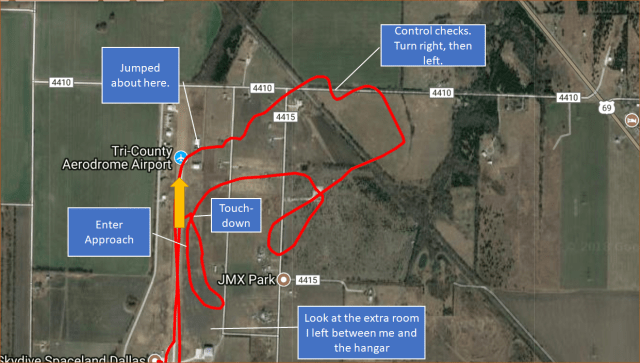
They came and picked me up with the golf cart. After dropping my gear, I went over the video of my jump with Bill. He called out the things I needed to work on, but he didn’t beat me up. He said I had very good altitude awareness. I guess if I want to get one thing right, knowing my distance to earth would be it! Talked with some of the other students for a while (had a couple there from Alaska – my favorite non Lone Star state). Got my logbook signed and filled out, and training jump #1 was officially in the books.
Driving back to work, I couldn’t help smiling. At least for now, skydiving is my “therapy”; it forces me to focus on the right now with such intensity that all the other crap just melts away. With all the stresses of normal life (work, etc), I need a hard reset like this; it lets me start with a fresh attitude. It’s also helping me learn some things about life (if a mangy old dog like me can learn any new tricks at this point):
- You don’t have to get everything perfect.
- That’s tough for a die hard computer guy to say. I have “BINARY” on my license plates for goodness sake (black or white, no grey area).
- Yet I didn’t have perfect form, didn’t nail my landing, and everything was still a success.
- It’s OK to have fear
- We are pre-loaded with basic fear instincts. But you can confront and manage it (I really did consider chickening out). I was more scared of screwing up the landing and looking foolish than scared of the jump (sad).
- Watch and learn from others
- There’s a lot of things to pick up in the training area watching instructors go over training videos with students, etc.
- Appreciate the differences in others
- Most the people working at the drop zone are die hard and live much different than what a lot of us know
- Many of them left college, quit the jobs they knew, or gave up businesses to follow the jumpers life; you have to admire the level of commitment required.
Without further ado, here is the training video from my first jump
 Trekking Geek
Omg. I love everything about this post (especially the life lessons) EXCEPT THE VIDEO!!! Stress me OUT!!! So proud/excited for you though. Thanks for sharing all this with us!!
LikeLiked by 1 person
Don’t stress the video! I was nervous at the time, but I look back now and realize it was just such a blast.
LikeLike