I knew I would need a lot of gear for the trip. Had I known what all it was, I probably would have bought some of it for my Alaska trip rather then renting most of my gear there. I will put a list of the gear at the bottom of this post. The main thing with any of the gear to consider is weight. For my flight into Lukla, I only have a baggage allotment of 15kg (roughly 33 pounds). That includes my spare clothes, backpack, medical supplies, and any electronics/personal gear. I chose to weigh everything that I was taking so I don’t have a surprise when I check in for the final leg of my air trip (Kathmandu to Lukla/Tenzing Hillary Airport). The reason they are so strict on weight is that Lukla is a high altitude (9,334 feet), short airstrip (1729 feet). Only two models of aircraft are allowed to land there because of these factors, and they want to know exactly how much that aircraft will weigh. They’ll weigh me as well (First time I ever had to weigh-in for an aircraft ride was when I took my air tour of Denali). I’ll make a post about Lukla after we land there and settle in for the night (*if I have internet).
I spent months researching gear, looking for it on sale. Black Friday provided some great opportunities to save some money; I picked up both my jackets (my lightweight insulated for the trail) and my heavy down jacket for the cold nights at the lodges and base camp (the lodges/tea houses our group will be staying at do not have heat). One of the few things I paid full price for was my sleeping bag. I ended up getting a Magma 10 (REI brand); it is rated to 10 degrees F and only weighs 2 pounds. It has also received several awards. My one complaint about the sleeping bag is it is very “fitted”. Once you zip up, there is not a lot of room to move your arms around. That will take some getting used to, but more fabric/insulation means more weight.
Early on, I thought I had all sorts of extra room for weight, but as I started adding in all the little things (medications, etc, it grew to the limit rather quickly). I ended up choosing to buy a new camera for this trip. The camera that I wanted to take is good, but with the extra battery, extra telephoto lens, charging sled, I was at 900 grams. And that wasn’t even with a case for the extra lens/battery/sled. That’s almost 2 pounds! Plus it wasn’t weather proof. I ended up going with an Olympus TG-5. The camera, case, spare battery come in at 325 grams, saving me almost a third of my camera weight. The other benefits is this new camera is environmental-proof (water/cold/dust), has a GPS so I can choose to geotag my pictures if I want, and a built in temperature sensor so I can also stamp my pictures with a temperature. Normally, good security practices are to not stamp photos with location, but I think for a trip like this it is proper. I also had to pull a pair of sandals from my gear and replace with a pair of super light flip flops from Walmart. I’ll need something to let my feet air out and wear in shower facilities, but they don’t need to kill pound of my weight limit.
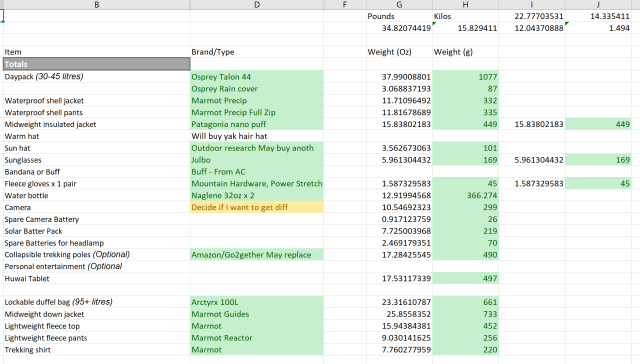
This has definitely changed the way I look at outdoor gear. Now when walking through the outdoor section at Walmart or Costco, the first thing that comes to mind is “how much does that weigh?”. Below is a partial screenshot of my tracking spreadsheet I made to keep up with my gear weight. Don’t grade me on spelling please (doesn’t change the numbers…). If you count everything, I’m 800 grams over. If you take out what I plan on wearing on the plane, that puts me at 14.3kg. That leaves me a little spare room and I can add in a few food items just in case I need them and remind me of home.
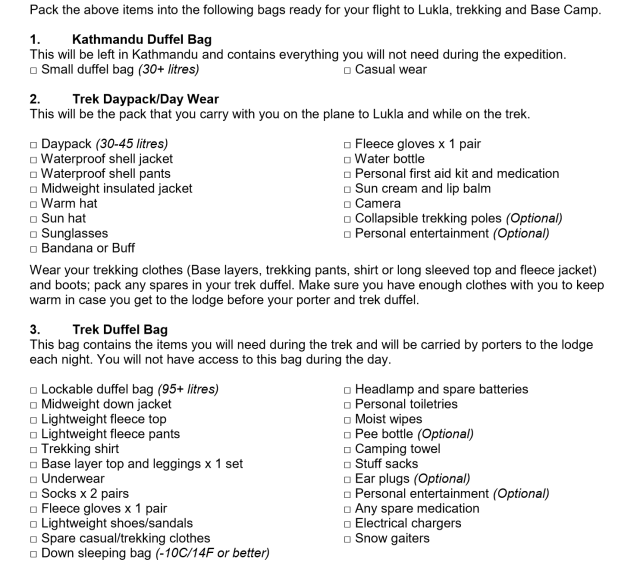
Big gear list. It doesn’t seem like that much, but once you start breaking it down into all the sub-items, it does get quite large.


 Trekking Geek